




UltraPath System
Ultraviolet and Visible Light Absorbance Spectroscopy (UPUV-2)
- Overview
- Specifications
- Accessories
- Citations
- Related Products
Overview
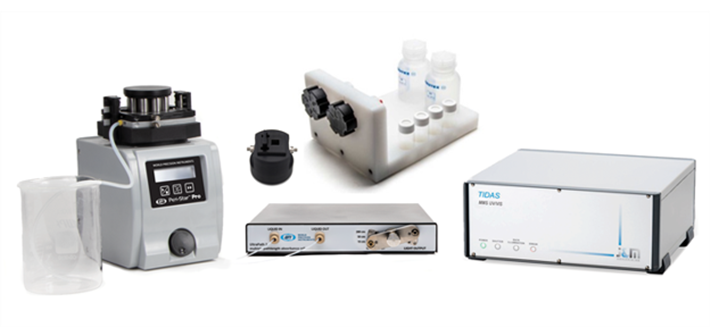
There are 1 images available to view - click to enlarge and scroll through the product gallery.
Ultrapath brochure
/ Download as PDF
Ultra Path Instruction Manual
/ Download as PDF
BENEFITS
- A unique multiple long pathlength sample cell for absorbance spectroscopy
- User-selected optical path lengths: 10, 50 & 200 cm
- Use for Process Control & Oceanography, for very low concentrations and low sample volumes
DETAILS
UltraPath™ is a unique high-performance spectrophotometer system offering user-selectable optical path lengths of 10, 50 and 200 cm. The instrument operates in the wavelength range of 250 to 720 nm and has an exceptional dynamic range. Designed for the detection of low absorbing species in aqueous solutions, UltraPath is an ideal tool for any study requiring precise and highly sensitive spectroscopic determination of analytes, either in the lab or in the field.
BACKGROUND
UltraPath was developed by WPI under a collaborative agreement with NASA (Stennis Space Center) for the spectroscopic determination of colored dissolved organic matter (CDOM) in seawater and fresh water environments. It can be used in the laboratory and in the field (i.e., at sea).
CDOM concentrations vary significantly between open ocean samples with low CDOM (e.g., 0.007 m-1 at 380 nm), and high CDOM freshwater environments (e.g., 10-20 m-1 at 380 nm). To address these problems the design requirements of UltraPath mandated the development of a rugged portable system capable of high sensitivity measurements across a wide dynamic range. The UltraPath system meets these stringent design criteria and enables reliable measurement of CDOM in the range of 0.002 m-1 to 230 m-1 (between 250 and 720 nm).
DESIGN
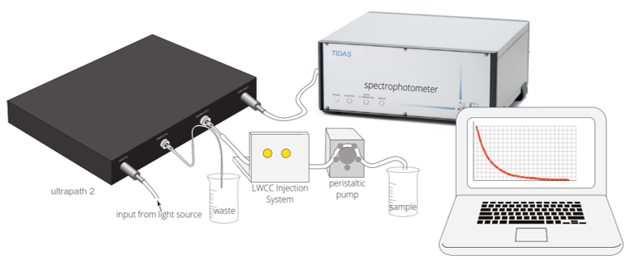
UltraPath has three optical pathlengths contained within a single sample cell (10 cm, 50 cm and 200 cm). The pathlengths are user-selectable, offering a very high sensitivity and an extended dynamic range for UV and VIS absorbance measurements. The fluid path of the sample cell is optimized to produce a laminar flow that is virtually free of interference from trapped air bubbles and adherence of dissolved substances to the cell wall. In particular, the design greatly minimizes the problems commonly found with flow cells of long optical pathlengths: the risk of trapping dust particles, fibers or particulate matter inside the cell. The UltraPath system includes a low noise photodiode array-based spectrometer module
PARTICULATE ABSORPTION
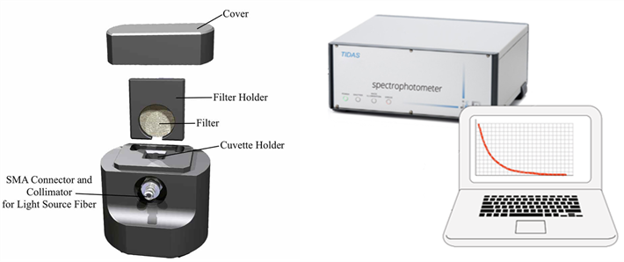
Particulate absorption can be measured by the well established Quantitative Filter Technique (QFT). The UltraPath-2 system includes a fiber optic filter holder for Glass Fiber Filters which can be used with the spectrophotometer so that particulate absorption can be measured on site, avoiding loss of spectral information due to freezing and shipping particulate samples to a laboratory.
SYSTEM INCLUDES
- UltraPath-2 Flow Cell
- UV/VIS Spectrometer system (190-720nm) including software, DH Light source (requires windows 10/11 PC/ laptop to run software)
- Fiber optic connection cables
- Liquid injector kit
- LWCC Injection System
- Peristaltic Pump
- Filter holder for particulate absorption measurement
The system is designed for mobility. The components of the UltraPath system are designed to function over a broad range of laboratory and field environments.
SAMPLES
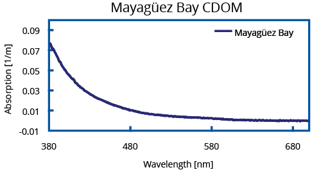
Two typical absorption spectra recorded with an UltraPath of a seawater and a fresh water sample collected in November 2007 are shown below. Due to their high absorbance, both samples were analyzed in the 10 cm pathlength. The CDOM sample labeled Mayagüez Bay in Fig. 2 is from oligotrophic, low productive waters with high salinity collected off the west coast of Puerto Rico in the Mayagüez Bay. Special attention should be drawn to the exceptional sensitivity of UltraPath enabling detection of CDOM absorption below 0.03 m-1. To exemplify the performance of the UltraPath in Laboratory Chemistry and Process Control, Ponceau S absorbance was measured with the 200 cm pathlength of an UltraPath. Normalizing the Ponceau absorbance graph to AU/cm, the range of this measurement is 150 μAU with a noise level below 2 μAU peak to peak. Sub-nanomolar concentration of this dye can clearly and reliably be detected, which is a novelty in absorbance based spectroscopy.
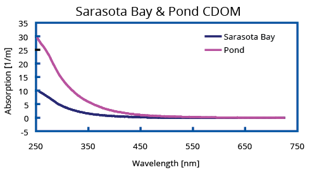
(Left) Two typical absorption spectra measured using UltraPath. The sample labelled “Sarasota Bay” is a CDOM sample with 34 PSU salinity collected from Sarasota Bay (Nov. 2007), and the sample labelled “Pond” is a highly concentrated CDOM sample collected from a local pond in Sarasota, Florida (Nov. 2007).
(Right) CDOM Sample “Mayagüez Bay” was collected from the high salinity oligotrophic waters of Mayagüez Bay on the west coast of Puerto Rico (2001). Data courtesy of NASA Stennis Space Center.
Specifications
| Dynamic range | 0.002 m-1 – 230 m-1 (Absorption) 5 μAU cm-1- 1 AU cm-1 (Absorbance) |
| Wavelength range | 250 nm to 720 nm |
| Wavelength resolution (FWHM) | 5 nm |
| Noise (peak to peak) | < 0.2 mAU |
| Drift | < 1 mAU/h |
| Optical pathlength | 10, 50 & 200 cm (user selectable) |
| Sample cell inner diameter | ~1 mm |
| Cell volume | 2.4 mL (at 200 cm pathlength) |
| Sample inlet/outlet | 1/8 " |
| Fiber input/output | 600 μm, SMA |
| Solvent resistance | Most organic and inorganic solvents |
| Shipping weight | 34 kg |


Request
Catalogue
Chat
Print