




MCT6-306
Mechanoculture T6 6-Well - High force uniaxial stimulation of 6 specimens in individual channels
A mechanical stimulation bioreactor configuration with 6 individual wells/channels. This format supports separation between specimens when different media, conditions, or sample isolation is required.
- Overview
- Specifications
- Accessories
- Citations
- Related Products
Overview
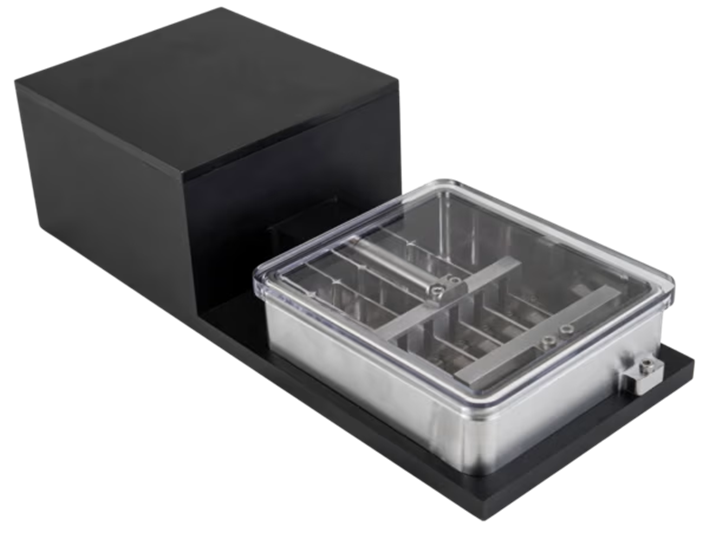
There are 1 images available to view - click to enlarge and scroll through the product gallery.
MCT6 Mechanoculture T6 Brochure
/ Download as PDF
- Uniaxial tension stretch conditioning in culture
- Up to 6 specimens in parallel
- High force tension stimulation (up to 200 N)
- Grip separation up to 80 mm
- PC-independent incubator operation
- Autoclavable culture-contacting components
The MechanoCulture T6 (MCT6) is a tension-stimulation system designed for long-duration culture experiments where controlled stretch is the stimulus and biological response is the output. It delivers repeatable uniaxial stretch stimulation to clamp-mounted constructs and soft tissues, with PC-independent operation for incubator-based studies.
This tension stimulation system is widely used as a tissue engineering bioreactor for structural constructs where controlled strain is applied over hours to days in an incubator. As a high-force uniaxial stimulation platform, the MCT6 is commonly selected when specimen gripping, high load capacity, and long grip separation are required for tissue engineering and mechanobiology setups. Researchers use it to apply cyclic and intermittent regimens that support mechanotransduction, maturation, and durability-oriented conditioning.
The MechanoCulture T6 can uniaxially stretch up to 6 clamp-mounted specimens from 5-80mm in length. For stimulation in tendon, ligament, and bone tissue engineering work, it can deliver up to 200N of thrust. For cardiovascular research, the system can stimulate at up to 2Hz.
All components in contact with the culture can be autoclaved and the device can be run inside an incubator environment. Stainless steel grips secure the specimens at each end. The spacing and geometry of these grips can be customized to suit a variety of specimen sizes and materials.
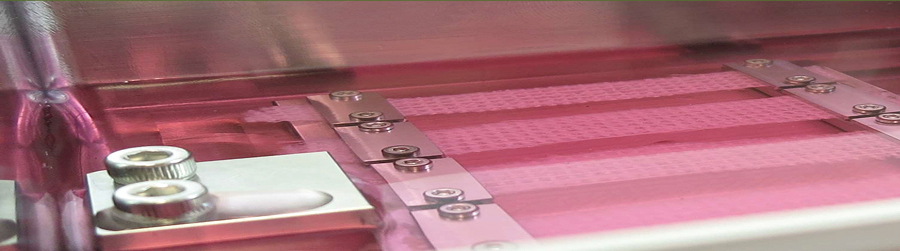
The MechanoCulture T6 can be programmed to run constant velocity or sinusoidal stretch patterns. Magnitudes, frequencies, rest periods, and cycle counts can all be specified in the software application and programmed to the device.
MechanoCulture T6 6-Well (MCT6-306)
 |
A mechanical stimulation bioreactor configuration with 6 individual wells/channels. This format supports separation between specimens when different media, conditions, or sample isolation is required.
|
What's Included
- Programming software (lifetime license)
- 6 sets of specimen grips
- Controller for up to 200 N uniaxial tension stimulation
Videos
Specifications
| Specification | MCT6 Standard (MCT6-200) | MCT6 6-Well (MCT6-306) |
| Stimulation Mode | Uniaxial tension | Uniaxial tension |
| Specimen Capacity | Up to 6 specimens | Up to 6 specimens |
| Culture Format | Shared bath environment | 6 individual wells/channels |
| Specimen Size | From 5 to 80 mm length | From 5 to 80 mm length |
| Loading Capacity | 200 N | 200 N |
| Media Volume | 100-300 mL | 100-300 mL |
| Grip Separation | Up to 80 mm | Up to 80 mm |
| Max Stretch | 25 mm | 25 mm |
| Max Velocity | 20 mm/s | 20 mm/s |
| Max Cycle Frequency | 2 Hz | 2 Hz |
| Autoclavable components | Yes | Yes |
| Dimensions | 36 X 15 X 9 cm | 36 X 15 X 9 cm |
| Weight | 3 Kg | 3 Kg |
| Common Uses | Tendon, ligament, musculoskeletal, and structural tissue constructs | Parallel cohorts requiring media separation or reduced sample cross-talk |
Accessories
Citations
James Britton, Katarzyna Krukiewicz, Malu Chandran, Jorge Fernandez, Anup Poudel, Jose-Ramon Sarasua, Una FitzGerald, Manus J.P. Biggs, (2021). A flexible strain-responsive sensor fabricated from a biocompatible electronic ink via an additive-manufacturing process. Materials & Design, Volume 206, 2021, 109700, ISSN 0264-1275, https://doi.org/10.1016/j.matdes.2021.109700.
Marc A. Fernandez-Yague,Alexandre Trotier,Secil Demir,Sunny Akogwu Abbah,Aitor Larrañaga,Arun Thirumaran,Aimee Stapleton,Syed A. M. Tofail,Matteo Palma,Michelle Kilcoyne,Abhay Pandit,Manus J. Biggs (2021). A Self-Powered Piezo-Bioelectric Device Regulates Tendon Repair-Associated Signaling Pathways through Modulation of Mechanosensitive Ion Channels.
Kailei Xu1,2,3†, Xixia Liu 2,3,4†, Xiaokeng Li 2,3, Jun Yin2,3, Peng Wei5, Jin Qian6* and Jie Sun1,7 (2021). Effect of Electrical and Electromechanical Stimulation on PC12 Cell Proliferation and Axon Outgrowth.
Hyeree Park, Showan N. Nazhat, Derek H. Rosenzweig (2021). Mechanical activation drives tenogenic differentiation of human mesenchymal stem cells in aligned dense collagen hydrogels. bioRxiv 2021.11.25.470026; doi: https://doi.org/10.1101/2021.11.25.470026
Alejandro Garcia Garcia,Jean-baptiste Perot,Megane Beldjilali-Labro,Quentin Dermigny,Marie Naudot,Sophie Le Ricousse,Cecile Legallais,Fahmi Bedoui (2021). Monitoring mechanical stimulation for optimal tendon tissue engineering: A mechanical and biological multiscale study. Journal of biomedical materials research. Part A vol. 109,10 (2021): 1881-1892. doi:10.1002/jbm.a.37180
Lin, J., Li, X., Yin, J. and Qian, J. (2020). Effect of Cyclic Stretch on Neuron Reorientation and Axon Outgrowth. Frontiers in bioengineering and biotechnology vol. 8 597867. 14 Dec. 2020, doi:10.3389/fbioe.2020.597867
Fernandez-Yague, M.A., Trotier, A., Abbah, S.A., Larrañaga, A., Thirumaran, A., Stapleton, A., Tofail, S.A., Palma, M., Pandit, A. and Biggs, M.J. (2020). Self-powered piezo-bioelectronic device mediates tendon repair through modulation of mechanosensitive ion channels. bioRxiv 2020.08.03.227868; doi: https://doi.org/10.1101/2020.08.03.227868
D. Kumar, S. A. Cain, L. A. Bosworth (2019). Effect Of Topography And Physical Stimulus On Hmsc Phenotype Using A 3d In Vitro Model. Nanomaterials (Basel, Switzerland) vol. 9,4 522. 3 Apr. 2019, doi:10.3390/nano9040522
J. Bracamonte, S. Saunders, S. Cole, G. Annohene, G. Tepper, J. Soares (2019). In vitro degradation of electrospun polycaprolactone tissue engineering scaffolds under cyclical dynamic loading.
D. Gaspar, Christina N. M. Ryan, Dimitrios I. Zeugolis (2019). Multifactorial Bottom-Up Bioengineering Approaches For The Development Of Living Tissues Substitutes. FASEB journal : official publication of the Federation of American Societies for Experimental Biology vol. 33,4 (2019): 5741-5754. doi:10.1096/fj.201802451R
M. S. Ali, X. Wang, C. M. R. Lacerda (2019). The Effect Of Physiological Stretch And The Valvular Endothelium On Mitral Valve Proteomes. Experimental biology and medicine (Maywood, N.J.) vol. 244,3 (2019): 241-251. doi:10.1177/1535370219829006
Mir Ali (2018). Mechanotransduction And Control Of Valvular Cell Phenotype As Tools To Inform Valvular Pathophysiology.
S. Wu, Y. Wang, P.N. Streubel, B. Duan (2017). Living Nanofiber Yarn-Based Woven Biotextiles For Tendon Tissue Engineering Using Cell Tri-Culture And Mechanical Stimulation. Acta biomaterialia vol. 62 (2017): 102-115. doi:10.1016/j.actbio.2017.08.043
F. Chen, G. Hochleitner, T. Woodfield, J. Groll, P. Dalton, B.G. Amsden (2016). Additive Manufacturing Of A Photo-Cross-Linkable Polymer Via Direct Meld Electrospinning Writing For Producing High Strength Structures. Biomacromolecules vol. 17,1 (2016): 208-14. doi:10.1021/acs.biomac.5b01316



Request
Catalogue
Chat
Print